
Introduction
Restylane and Belotero are two leading dermal filler families in the UK market, both backed by extensive clinical evidence and diverse product ranges. For aesthetic practitioners, the decision between them depends on patient indications, treatment area, and desired tissue integration properties. This review examines their composition, mechanisms, product lines, safety profiles, and clinical study outcomes.
What is Restylane?
Composition and Technology
Restylane is a hyaluronic acid (HA) dermal filler range by Galderma, manufactured using two main technologies:
- NASHA™ (Non-Animal Stabilised Hyaluronic Acid) – produces firmer gels with higher lifting capacity, ideal for structure and definition.
- OBT™ (Optimal Balance Technology) – produces softer, more flexible gels designed for natural expression and dynamic areas.
Crosslinking is achieved with BDDE (1,4-Butanediol Diglycidyl Ether) for longevity, with HA concentrations ranging from 20 mg/mL to 25 mg/mL depending on the product.
Restylane Product Line Breakdown

| Product | HA Conc. | Technology | Main Indications | Longevity | Injection Depth |
| Restylane Classic | 20 mg/mL | NASHA | Moderate wrinkles, lips | 6–9 months | Mid-dermis |
| Restylane Lyft | 20 mg/mL | NASHA | Cheek augmentation, chin, jawline | 9–12 months | Deep dermis/supraperiosteal |
| Restylane Kysse | 20 mg/mL | OBT | Lips, perioral lines | Up to 12 months | Mid-to-deep dermis |
| Restylane Refyne | 20 mg/mL | OBT | Moderate dynamic wrinkles | Up to 12 months | Mid-to-deep dermis |
| Restylane Defyne | 25 mg/mL | OBT | Deep dynamic wrinkles, folds | Up to 12 months | Deep dermis |
| Restylane Volyme | 20 mg/mL | OBT | Facial volumisation | 12–15 months | Deep dermis/supraperiosteal |
| Restylane Skinboosters (Vital, Vital Light) | 12–20 mg/mL | NASHA | Skin hydration, texture | Series of 3 sessions | Dermis |
What is Belotero?
Composition and Technology
Belotero is a HA dermal filler family by Merz Aesthetics, created with Cohesive Polydensified Matrix (CPM®) Technology. This manufacturing method produces a cohesive gel that integrates seamlessly into the dermis, reducing the risk of Tyndall effect and providing smooth transitions in the skin.
HA concentration ranges from 22.5 mg/mL to 26 mg/mL depending on the formulation, all crosslinked with BDDE.
Belotero Product Line Breakdown
| Product | HA Conc. | Main Indications | Longevity | Injection Depth |
| Belotero Soft | 20 mg/mL | Fine lines, perioral lines | 6–9 months | Superficial to mid-dermis |
| Belotero Balance | 22.5 mg/mL | Moderate lines, nasolabial folds | 6–12 months | Mid-dermis |
| Belotero Intense | 25.5 mg/mL | Deep lines, lip enhancement | 9–12 months | Mid-to-deep dermis |
| Belotero Volume | 26 mg/mL | Cheeks, chin, temples | 12–18 months | Deep dermis/supraperiosteal |
| Belotero Revive | 20 mg/mL + glycerol | Skin hydration, elasticity | Series of 2–3 | Superficial dermis |
Clinical Comparison
#image_title
Tissue Integration and Rheology
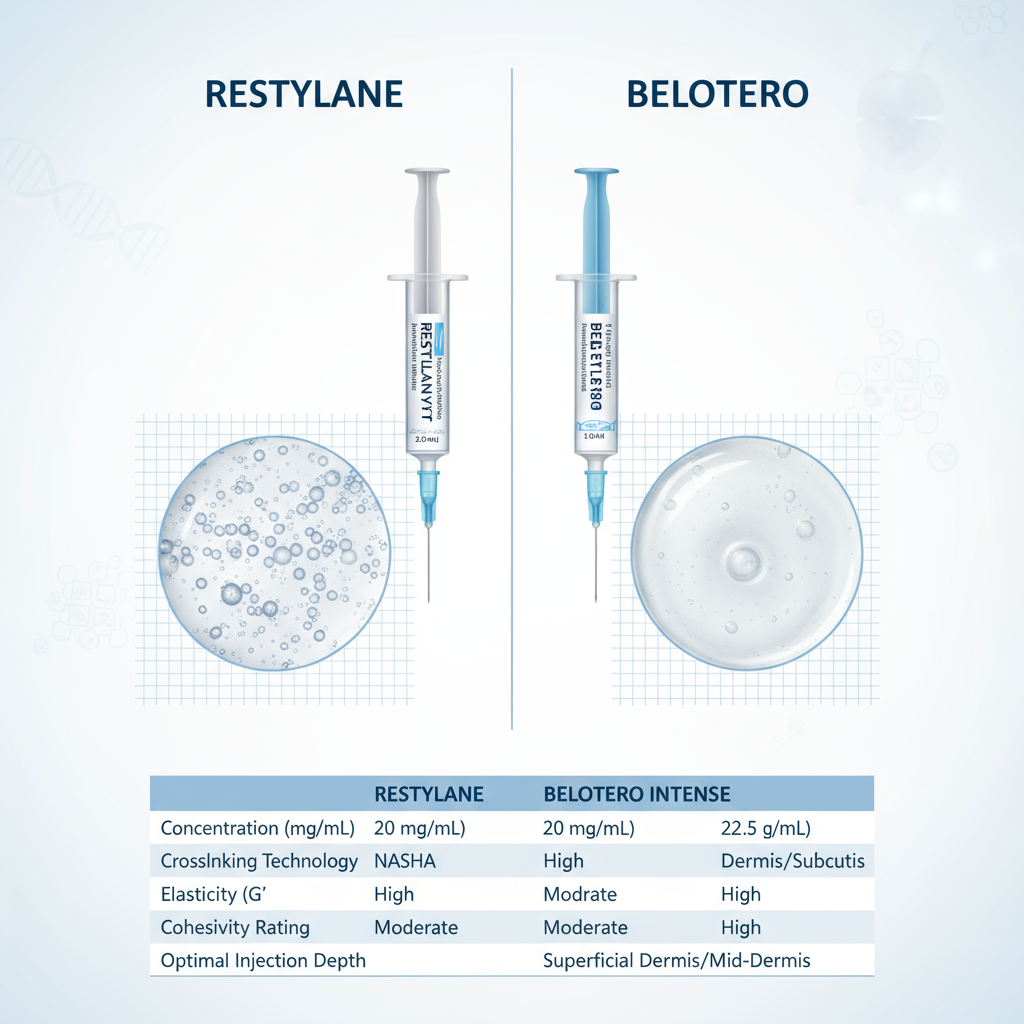
- Restylane NASHA products are firmer and provide lift, while OBT products are more elastic for natural facial movement.
- Belotero CPM® products integrate more uniformly within the dermis, which may reduce lumpiness in thin-skinned areas.
Indication-Based Preference
- Under-eye / Tear Trough: Belotero Balance or Restylane Refyne for smooth integration and minimal Tyndall risk.
- Cheek Augmentation: Restylane Lyft or Belotero Volume for projection and lift.
- Fine Lines: Belotero Soft or Restylane Skinboosters for dermal smoothing.
- Dynamic Wrinkles: Restylane Refyne/Defyne or Belotero Balance for balance between structure and flexibility.
Peer-Reviewed Study Insights
- Beleznay et al., Dermatologic Surgery, 2021: Compared filler performance in tear trough correction — Belotero Balance showed smoother dermal integration and lower Tyndall incidence than firmer gels.
- Sundaram et al., Aesthetic Surgery Journal, 2020: Found Restylane Refyne and Defyne maintained elasticity and projection in dynamic areas up to 12 months.
- Swift et al., Plastic and Reconstructive Surgery, 2019: Demonstrated high patient satisfaction (>90%) with Restylane Lyft in mid-face volumisation.
Safety and Side Effects
Both brands have similar safety profiles:
- Temporary erythema, swelling, tenderness
- Rare vascular occlusion risk
- Avoid in pregnancy, breastfeeding, and patients with HA hypersensitivity
Technique, depth, and appropriate product selection are key to minimising adverse events.

#image_title
Conclusion
Restylane and Belotero are both clinically validated, versatile filler portfolios. Selection depends on patient anatomy, indication, and desired integration characteristics.
For structural lift and projection: Restylane NASHA/OBT range.
For seamless dermal integration and fine line correction: Belotero CPM® range.
Ready to stock these in your clinic?
- Buy Restylane now: https://skinonyou.com/product-category/dermal-fillers/restylane/
- Buy Belotero now: https://skinonyou.com/product-category/dermal-fillers/belotero/