
Description
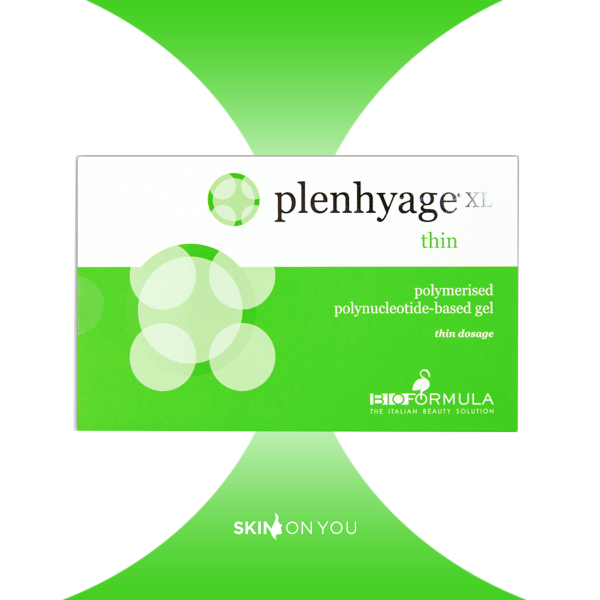
Plenhyage XL Thin 1 × 2 ml – In stock
Clinical Description
Plenhyage XL Thin is a Class III injectable medical-device from Bioformula s.r.l. (Italy) based on high-molecular-weight polynucleotides (PDRN) for professional use. Its core mechanism entails the stimulation of fibroblasts, support of collagen and extracellular-matrix regeneration, and hydration via polymerised DNA fragments derived from salmon sperm DNA, fully biocompatible and resorbable. Indicated for improving skin quality in delicate, thin, fragile or photo-aged zones (rather than for volumetric filling), Plenhyage XL Thin acts as a biorevitaliser/skin-booster to restore tone, elasticity and structure of the skin.
What Plenhyage XL Thin Is Similar To
Plenhyage XL Thin occupies the category of polynucleotide-based biostimulation injectables, akin to products such as Jalupro (which combine amino acids + PDRN) and the broader range of Plenhyage XL (Medium and Strong). For example, Jalupro offers skin-quality improvement by stimulating fibroblasts and ECM repair; similarly Plenhyage XL Thin focuses on cellular renewal using PDRN. The main difference lies in indication and concentration: while Jalupro may include peptides and amino acids, Plenhyage XL Thin is a dedicated high-molecular polynucleotide gel with very delicate skin indication [2]. Compared to its sibling formulations such as Plenhyage XL Medium (≈2 %) or Strong (≈2.5 %) [3], Thin employs a lower concentration better suited to fragile zones. This comparison is provided for clinical orientation only and does not imply interchangeability.
Treatment Areas / Indications
According to marketing/manufacturer information:
-
Face: delicate zones (thin skin)
-
Periorbital area (around the eyes)
-
Neck and décolletage
-
Sensitive or fragile skin zones & post-treatment support (laser/peel)
-
If strictly following the manufacturer IFU, the full list of indicated areas is: “face, neck and décolleté”.
Usage / Administration (IFU-only section)
-
Injection depth: not provided by manufacturer for this specific “Thin” variant.
-
Volume per point/injection site: not provided by manufacturer.
-
Needle gauge: not provided by manufacturer.
-
Frequency / number of sessions: Manufacturer states “multiple sessions are usually required; doctor to develop a personalised treatment plan.”
Some professional sources note a recommended course of 2-4 sessions at 14-21 day intervals, followed by a maintenance session every 3-6 months. (This is not part of the official manufacturer IFU).
-
Professional-use disclaimer: “Intended for professional medical use only” and “administered by qualified medical professionals under aseptic conditions”.
Ingredient List
-
Polynucleotides (PDRN), high molecular weight ~0.75 % for Thin variant.
-
Sterile Water.
-
Buffering Solution.Lidocaine: not provided by manufacturer.
-
HA concentration: not applicable / not provided by manufacturer, as this is a polynucleotide-based product, not a hyaluronic acid filler.
Presentation & Longevity
-
Packaging: 1 pre-filled glass syringe of 2 mL with 2 disposable needles.
-
Shelf life/storage: not provided by manufacturer in publicly accessible sources.
-
Longevity/duration of effect: While the manufacturer states “duration varies depending on individual needs” some distributor information cites up to 4-6 months for Thin variant.
Safety Notes / Contraindications
-
Contraindicated in patients with known hypersensitivity to any component of the device.
-
Contraindicated at injection sites with active skin infection or inflammation.
-
Use is not indicated for pregnant or breastfeeding women as per some sources.
-
Use is for professional medical use only — improper use may increase risk of adverse events.
-
Note: Since the manufacturer did not provide a full public IFU on injection depth or techniques, practitioners must adhere to local regulatory and best-practice guidelines for polynucleotide injections.
Regulatory Status
-
CE marked: Class III medical device, CE 0373.
-
UKCA: not explicitly stated in the publicly available documentation; verify on product pack or with distributor.
-
FDA: No US FDA 510(k) or PMA cleared status found in the publicly available documentation — verify with manufacturer or regulatory database.
FAQ
How does Plenhyage XL Thin work?
Plenhyage XL Thin uses high-molecular-weight polynucleotides (PDRN), which stimulate fibroblast activity and extracellular-matrix regeneration, support hydration by binding water, and improve skin elasticity and texture [1]. The device thereby enhances the skin’s structural environment rather than volumising it.
Is the treatment safe?
Yes — as a Class III CE-marked device for professional use only, Plenhyage XL Thin has a documented safety profile for its intended use. Transient injection-site reactions (redness, swelling, bruising) may occur, as with any injectable device [1]. Proper patient selection (excluding active infection, hypersensitivity, pregnant/breastfeeding women) and aseptic technique are essential.
What is the recommended treatment schedule?
The manufacturer states that multiple sessions are required and a personalised plan should be developed by the clinician [1]. Some professional sources (not in the official IFU) indicate 2-4 sessions at 14-21 day intervals with maintenance at 3-6 months [4].
How long do results typically last?
The official manufacturer information states that duration varies depending on skin condition and treatment area [1]. Distributor-listed information for Thin suggests results typically last 4-6 months [5]. Individual outcomes may differ.
How does Plenhyage XL Thin compare to hyaluronic-acid fillers?
Unlike traditional hyaluronic-acid dermal fillers, which primarily provide volume and structure, Plenhyage XL Thin is designed for skin-quality improvement via biostimulation rather than volumisation [2]. It is especially suited for thin, delicate skin zones where adding volume is not desirable. It should be selected based on indication rather than being considered a direct substitute for HA fillers.