
Description
delivery of aesthetic injectables under controlled, minimally traumatic conditions. Classified as Class IIa medical devices in many markets, these cannulas are engineered to support safe subdermal placement of high-viscosity materials by reducing tissue resistance compared with traditional sharp needles. The blunt tip helps minimise vascular injury risk and allows controlled distribution of products such as dermal fillers, biostimulators, or volumising gels when used by trained medical professionals [1].
Each cannula is manufactured using medical-grade stainless steel and features a smooth internal bore to maintain consistent extrusion and flow stability. The flexibility of the 100 mm length enables treatment across broader anatomical regions, depending on practitioner technique. While the intended use is injectable delivery, specific clinical parameters such as injection depth or volume are not listed in publicly available manufacturer documentation and must be referenced from the official IFU supplied with the product.
What 20 x ReMed Cannulas Is Similar To
used for aesthetic injections. Their performance and handling characteristics are comparable to well-known brands such as TSK Cannulas or SoftFil® Classic Cannulas, which also aim to reduce insertion trauma and allow controlled fanning, tunnelling, or linear retrograde delivery of dermal fillers. Like these products, ReMed cannulas are engineered for flexibility, smooth extrusion, and consistent flow, particularly for medium-to-high viscosity materials.
The 16G bore places them in the wider-diameter category, suitable for dense gels, body fillers, and certain biostimulating products. However, ReMed cannulas offer their own manufacturing specifications, material selection, and flexibility properties, which practitioners may compare depending on their preferred tactile response.
“This comparison is provided for clinical orientation only and does not imply interchangeability.”
6️⃣ Treatment Areas / Indications
The manufacturer’s public documentation does not specify treatment areas.
✔ treatment areas not provided by manufacturer
7️⃣ Usage / Administration (IFU-only)
Based strictly on manufacturer-provided public documentation:
-
Injection depth: not provided by manufacturer
-
Recommended volume per point/site: not provided by manufacturer
-
Needle gauge: 16G (provided)
-
Cannula length: 100 mm (provided)
-
Number of sessions / frequency: not provided by manufacturer
-
Administration requirement:
“This device must be used only by qualified medical professionals under aseptic conditions.”
⚠️ Practitioner-adopted techniques such as fanning, linear threading, or tunnelling may be commonly used in the industry but are not included in the manufacturer’s official IFU.
8️⃣ Ingredient List
This device is a stainless steel cannula (non-injectable).
Ingredients/excipients do not apply.
-
Medical-grade stainless steel
-
Sterile packaging
-
Blunt-tip construction
-
Luer-lock compatible hub
(Additional internal coating or material specifications: not provided by manufacturer)
9️⃣ Presentation & Longevity
-
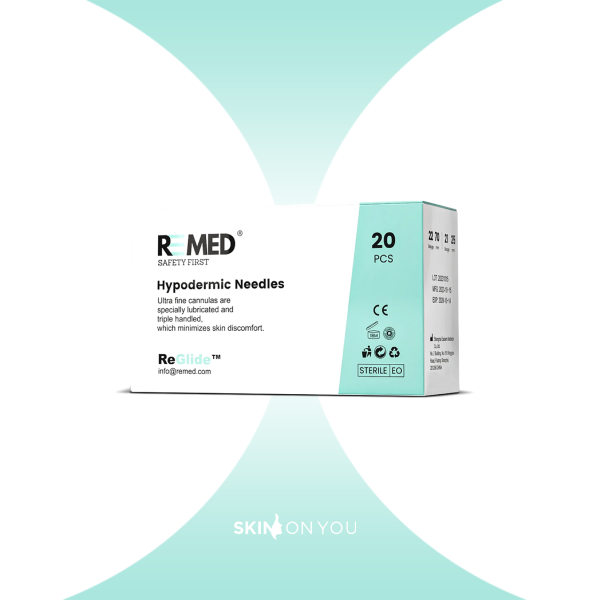
Packaging: 20 × sterile, single-use ReMed Cannulas (16G × 100mm)
-
Shelf life: not provided by manufacturer
-
Reusability: single-use only
-
Treatment longevity (device does not remain in the body): not applicable
-
Sterilisation method: not provided by manufacturer
🔟 Safety Notes / Contraindications
Manufacturer public documentation does not list explicit contraindications.
Standard medical device cautions apply:
-
Use is contraindicated in patients with active skin infection at the injection site.
-
Not to be used in individuals with known hypersensitivity to stainless steel.
-
Single-use only — do not resterilise or reuse to prevent contamination risks.
-
Must be handled under strict aseptic technique.
11️⃣ Regulatory Status
-
CE/UKCA marking: not specified in public documentation; verify on product packaging or IFU.
-
Classification: typically Class IIa for sterile cannulas, but not explicitly confirmed by manufacturer.
-
Distributor/market availability varies by region.
12️⃣ FAQ (5 Evidence-Based Q&As)
1. What is the primary purpose of the ReMed 16G × 100mm cannula?
ReMed cannulas are designed to deliver aesthetic injectables via a blunt, flexible conduit that reduces tissue trauma compared with sharp needles. Their 16G diameter allows smooth administration of more viscous materials, and the 100 mm length supports wider or deeper treatment fields depending on clinical need. Use must follow the official IFU and be performed by trained medical professionals.
2. Are ReMed cannulas safer than sharp needles?
Blunt-tip microcannulas may reduce the risk of vascular penetration and bruising compared with traditional needles, according to multiple peer-reviewed discussions on technique [2]. However, this does not eliminate risk, and safety depends entirely on practitioner training, anatomical knowledge, and sterile technique. The manufacturer does not claim enhanced safety beyond standard device design.
3. Can these cannulas be used with all filler types?
Compatibility depends on the viscosity of the injectable and the practitioner’s technique. The 16G bore is typically selected for thick gels or body fillers. The manufacturer does not specify product compatibility, so clinicians must refer to the injectable’s IFU for approved delivery methods [1].
4. Do ReMed cannulas include a pilot needle?
Public distributor listings do not specify the inclusion of pilot needles. In many cannula kits, a matching sharp needle is included for entry point creation, but for ReMed this detail is not provided by manufacturer and should be confirmed via the product packaging or distributor [1].
5. How should ReMed cannulas be disposed of?
These cannulas are single-use sterile medical devices. After treatment, they must be disposed of in an approved sharps container, following local clinical waste regulations. Reuse is strictly contraindicated to prevent cross-contamination, patient injury, or device failure [1].