
Description
Clinical Description
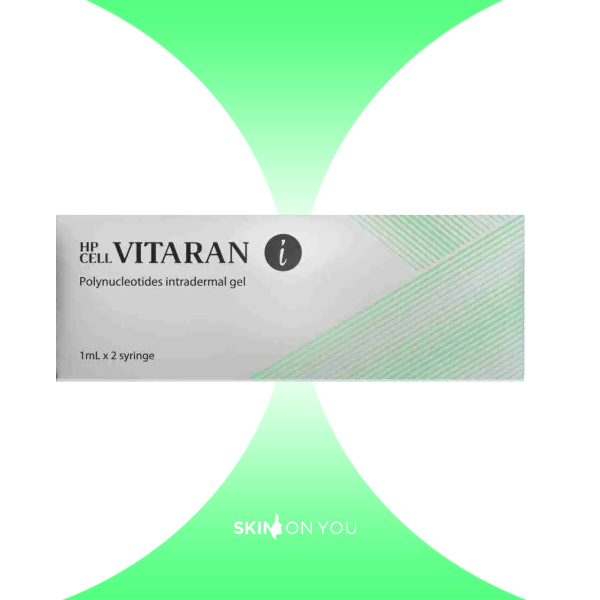
VITARAN I is a CE-marked polynucleotide (PDRN) injectable from the VITARAN range, formulated with highly purified salmon-trout DNA fragments at 20 mg/mL (PN 2%). It acts as a bio-revitalizing skin injectable, with a mechanism based on cellular stimulation rather than volumization: injected PDRN fragments aim to stimulate fibroblasts, support collagen and elastin synthesis, enhance extracellular matrix remodeling, and promote skin regeneration and repair. The main clinical indication is improvement of skin quality — addressing signs of aging, fine lines, skin laxity, and weakened skin barrier — particularly in delicate areas such as under-eye (periorbital) region.
What VITARAN I Is Similar To
VITARAN I belongs to the class of polynucleotide-based skin boosters rather than traditional hyaluronic acid (HA) fillers. For orientation, it can be compared to other skin-revitalizing injectables that target skin quality, hydration, and regeneration rather than structural volumizing. In contrast with HA-fillers (designed for volume restoration and contour correction), VITARAN I’s mechanism is regenerative — focusing on stimulating fibroblasts, collagen & elastin synthesis, and improving skin texture and elasticity. Compared with superficial skin-boosters or mesotherapy serums, VITARAN I offers a higher concentration of PDRN and sterile injectable presentation (syringes + needles), which may allow for deeper, more controlled delivery.
This comparison is provided for clinical orientation only and does not imply interchangeability.
Treatment Areas / Indications
-
Under-eye / periorbital region (delicate skin zones) — primary indication.
-
The general VITARAN range (other formats) lists additional areas such as face, neck, décolletage, hands, and other small facial/body zones — but for VITARAN I (2 × 1 ml), only peri-orbital / under-eye is explicitly indicated in publicly available documentation.
Usage / Administration (IFU-only section)
-
Injection depth / method: Not provided by manufacturer (no publicly accessible IFU specifying depth).
-
Needle gauge / included needle: 33 G (sterile needle supplied with each syringe) per product listing.
-
Volume per point / injection site: Not provided by manufacturer.
-
Frequency / number of sessions: Not provided by manufacturer in public documentation. Some retailers mention general “skin-booster training required” but do not specify protocol.
-
Professional-use disclaimer: The product is provided only to qualified aesthetic practitioners, requiring relevant skin-booster or polynucleotide certification.
Because the public documentation lacks a comprehensive IFU, practitioners must rely on the official IFU supplied with the product before performing treatment.
Ingredient List
-
Polynucleotide sodium (PDRN) — 20 mg/mL (PN 2%)
-
Buffer/solvent (q.s.) — as per manufacturer; specific excipients not publicly listed.
No hyaluronic acid, lidocaine, or cross-linked HA gel matrix is declared for this product in publicly available sources.
Presentation & Longevity
-
Packaging: 2 × 1 ml sterile syringes with 33 G sterile needles included.
-
Shelf life / expiry: Not provided in publicly accessible documentation.
-
Expected duration of effect: Not provided by manufacturer as a bio-revitalizing skin booster, the effect depends on individual skin response, frequency of treatments, and aftercare.
Safety Notes / Contraindications
Based on publicly available information from distributors and product pages:
-
Product should only be used by qualified professionals with appropriate skin-booster or polynucleotide certification.
-
Not suitable for patients with known allergy or hypersensitivity to fish (salmon-trout) DNA or any component in the formulation.
-
Avoid use if active skin infection, inflammation, or compromised skin integrity at the injection site.
-
Use caution for patients with immune disorders, tendency to keloid formation, or those under immunosuppressive or blood-thinning therapies (common caution for injectables; though not all are explicitly listed).
Regulatory Status
-
CE-marked medical-aesthetic polynucleotide injectable.
-
No public listing that confirms UKCA marking — practitioners should verify regulatory labeling on product packaging or IFU before use in UK.
FAQ
Q1: What is PDRN and how does VITARAN I work?
A1: PDRN (polynucleotide sodium) consists of purified DNA fragments (from salmon-trout in VITARAN), which when injected into skin tissue act as bio-stimulators. It is believed to stimulate fibroblast activity, supporting collagen and elastin synthesis, enhancing extracellular matrix remodeling, and aiding skin repair at a cellular level — rather than providing volume as a filler would.
Q2: Is VITARAN I a volumising filler?
A2: No — VITARAN I is a skin-booster injectable based on polynucleotides, not hyaluronic acid or cross-linked gel. It is intended to improve skin quality (texture, elasticity, regeneration) rather than add structural volume or contour.
Q3: For which areas is VITARAN I indicated?
A3: Public documentation indicates VITARAN I is primarily intended for the under-eye / periorbital region — i.e. delicate areas where improved skin quality, hydration, and reduction of fine lines are desired. Use outside this indication should be evaluated carefully and based on official IFU.
Q4: What is the recommended injection protocol for VITARAN I?
A4: The publicly available sources do not provide detailed protocol parameters such as injection depth, volume per point, or session frequency. Only that the product includes 33 G needles and is designed for use by trained professionals. Practitioners should rely on the official IFU supplied with the product for accurate protocol guidance.
Q5: What are the main safety considerations with VITARAN I?
A5: Key safety considerations include avoiding treatment in individuals with known hypersensitivity to polynucleotides (or fish-derived DNA), in pregnant or breastfeeding patients (if contraindicated), and in cases of active skin infection or inflammation at the target area. Treatment must be performed under aseptic conditions by qualified professionals. Because PDRN is biologically derived, full patient history and risk assessment are essential.