

Description
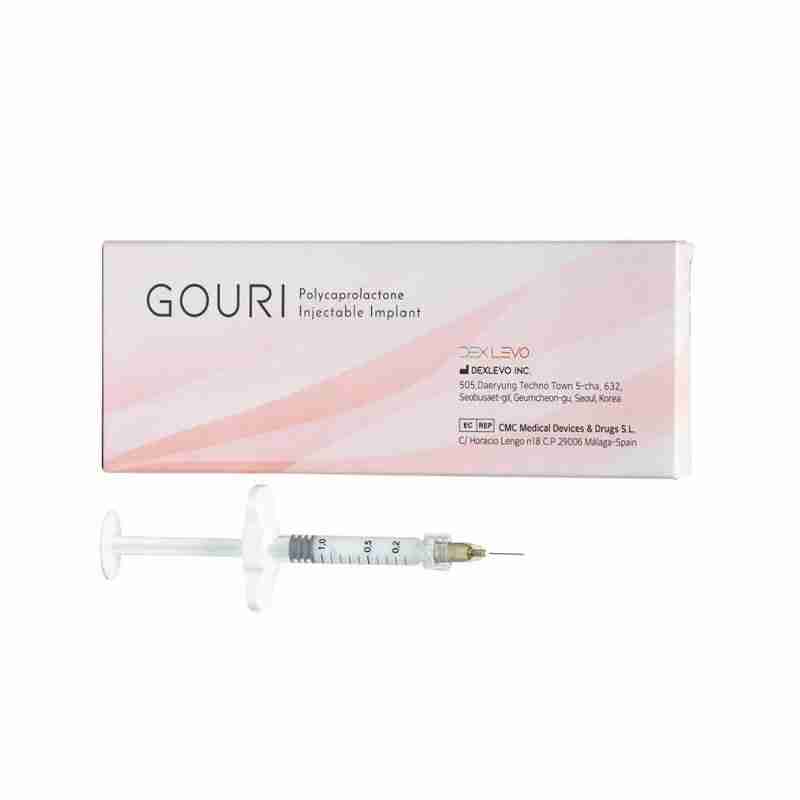
Gouri – Liquid PCL (Polycaprolactone) 1 × 1 mL
Gouri®, also referred to as Liquid PCL, is an injectable polycaprolactone (PCL) biostimulator medical device formulated to support natural collagen regeneration (collagenesis) in the skin through a fully solubilised liquid PCL solution. Unlike traditional microparticle fillers, Gouri’s liquid PCL spreads evenly within the dermal and subdermal layers to stimulate fibroblasts and encourage the body’s own production of collagen and elastin, addressing signs of aging such as skin laxity, fine lines, and decreased elasticity. The product is typically administered across multiple sites with fine needles and may be used for broad facial rejuvenation rather than focal volumetric correction.
The liquid PCL formulation makes Gouri adaptable for more uniform tissue distribution compared with particulate PCL or suspended fillers, which can require shaping after injection. It is intended for use by qualified medical professionals experienced in facial anatomy and collagen stimulation techniques.
What Gouri Liquid PCL Is Similar To
Gouri PCL can be regarded alongside collagen stimulator injectables such as Sculptra® (poly-L-lactic acid) and other PCL-based products, in that all are designed to promote endogenous collagen production rather than solely providing immediate volume like hyaluronic acid dermal fillers. However, unlike particulate PCL or PLLA products that encapsulate solid particles requiring reconstitution and carry a higher risk of nodule formation, Gouri’s liquid formulation is fully solubilised, allowing smoother injection and broader tissue distribution. Compared with HA-based skin boosters (e.g., Profhilo®), which primarily hydrate and improve matrix quality, Gouri emphasises longer-term collagenogenesis and tissue firmness due to PCL’s polymer structure and sustained biostimulatory effect.
This comparison is provided for clinical orientation only and does not imply interchangeability.
Treatment Areas / Indications
According to available product information, Gouri Liquid PCL is indicated for:
-
Full-face collagen stimulation and generalized rejuvenation.
-
Improvement of skin elasticity and firmness across facial zones.
-
Support for deeper wrinkles and skin laxity associated with aging.
Gouri is typically injected into the dermal or subdermal layers of the face and may be used around areas such as cheeks, forehead, temple, and under-eye zones, depending on clinical assessment.
Usage / Administration (IFU-Only)
-
Injection depth: Dermal or subdermal layer.
-
Volume per injection site: Not provided by manufacturer.
-
Needle gauge: Recommended 30 G to 35 G needles. Frequency / number of sessions: Many professional protocols recommend 3 treatment sessions spaced about 4 weeks apart, followed by maintenance every 3–6 months; however, official IFU details may vary by country and supplier.
-
Professional-use disclaimer: Administered only by qualified medical professionals under aseptic conditions.
If a parameter is omitted in the official IFU or manufacturer documentation, it is recorded as “not provided by manufacturer.”
Ingredient List
- Polycaprolactone (PCL) – 210 mg/mL (fully solubilised liquid PCL).
- Physiologic buffer/excipients as per IFU; additional trace components not publicly disclosed.
PCL is a biodegradable, biocompatible polymer used widely in aesthetic and medical applications for its ability to induce collagen production as it degrades.
Presentation & Longevity
-
Presentation: 1 × 1 mL pre-filled syringe of liquid PCL injectable.
-
Longevity: Clinical sources indicate that results may be sustained for up to approximately 6–12 months following a complete treatment protocol, depending on patient factors such as age, metabolism, and skin condition.
Safety Notes / Contraindications
-
Use is contraindicated in patients with known hypersensitivity to polycaprolactone or any component of the product.
-
Avoid injecting into areas with active skin infection, inflammation, or compromised integrity until resolved.
-
Do not administer intravenously or into non-target tissues.
-
Strict aseptic technique, appropriate anatomical knowledge, and trained clinical judgement are essential to minimize risk.
-
Follow local regulatory guidance and product instructions when administering Gouri Liquid PCL.
Regulatory Status
Regulatory classification for Gouri PCL varies by source and supplier; verify CE-marking, UKCA status, or other regional regulatory markings on the official Instructions for Use or product packaging prior to use.
FAQ
1. What is Gouri PCL and how does it work?
Gouri PCL is a liquid polycaprolactone (PCL) injectable designed to stimulate natural collagen production in the dermal and subdermal layers. Upon injection, the liquid PCL spreads evenly and forms a biostimulatory matrix that activates fibroblasts to produce new collagen over time, improving skin elasticity and firmness.
2. Is Gouri the same as a traditional dermal filler?
No. Unlike traditional HA fillers that provide immediate volume, Gouri is a biostimulator that encourages long-term collagenogenesis. Its effect is more gradual and sustained, focusing on tissue quality and firmness rather than focal volumetric augmentation.
3. How are Gouri treatments typically administered?
Gouri is administered into the dermal or subdermal layers with fine needles (30 G to 35 G). Professional protocols often involve multiple sessions spaced weeks apart to cumulatively stimulate collagen production across the face.
4. How long do results last after Gouri PCL treatment?
Results may continue to develop over weeks following injection and are commonly reported to last up to approximately 6–12 months, depending on individual response and treatment protocol.
5. Can Gouri PCL be used with other aesthetic treatments?
While professionals may integrate Gouri with other modalities (e.g., HA fillers, neuromodulators, skin boosters), it is important to space treatments appropriately and follow clinical judgment and product guidance; official IFU instructions should be consulted for safety. Not all adjunct protocols are provided by the manufacturer and should be regarded as practitioner discretion.